
501 decisions measured · production configuration
Claims, returns and approvals, decided in seconds and measured to the cent.
Bayes reads the documents of each case, applies your rules one by one and decides, with the evidence attached. When it isn’t sure, it hands the case to your team. You see every number.
Decision quality
- Correct, or escalated when that was right442
- To a person, could have decided53
- Wrong without escalating · none adverse6
- Decisions
- 501
- Cost per case · median
- US$0.017
- Time per case · median
- 14.6 s
167 synthetic test cases × 3 runs, production configuration. Fictional companies, not customers. What the 6 wrong ones were
Each question goes to the cheapest tier that can settle it.
The reader turns documents into facts with quotes. Then the gate: rules first, then a System One model, then a reasoning model, then a person. Every answer records who gave it and how sure it was.
Document reader
Transcribes PDF, images, email and text, classifies each document into the package’s types and extracts typed facts. Every quote is checked word for word against the document: if it isn’t there, the fact stays missing, not invented.
97.4 % read without error258 of 265 generated cases (v1.1); 100 % on the 31 v1 cases
-
Tier 1
Rules, in code
Dates, time zones, amounts, caps and chained exceptions are always computed by code, never by a model.
85.4% · millisecondsof rule evaluations, deterministic
-
Tier 2
System One · Jev
Typed questions (yes or no, a choice, a scale) answered with a probability distribution by Jev, TypeSafe’s System One model, through the Vercel AI Gateway.
1.7% · ~US$0.0001 · ~0.9 sof rule evaluations · cost and time per case, median
-
Tier 3
Reasoning model
Reads the documents and answers with verified citations. A tier that isn’t calibrated never settles a blocking question alone: the reasoning model has to confirm it.
11.0% · confirms or escalatesof rule evaluations; below its threshold, it doesn’t decide
-
Tier 4
A person
The console shows the typed question, the clause, what each tier answered with its confidence, and the evidence. The answer continues the case.
1.9% · wait and answer timedof rule evaluations
Shares of rule evaluations from the v1 evaluation: 1,086 rule evaluations in 93 runs, when System One was emulated. Jev’s cost and time are from v1.1.
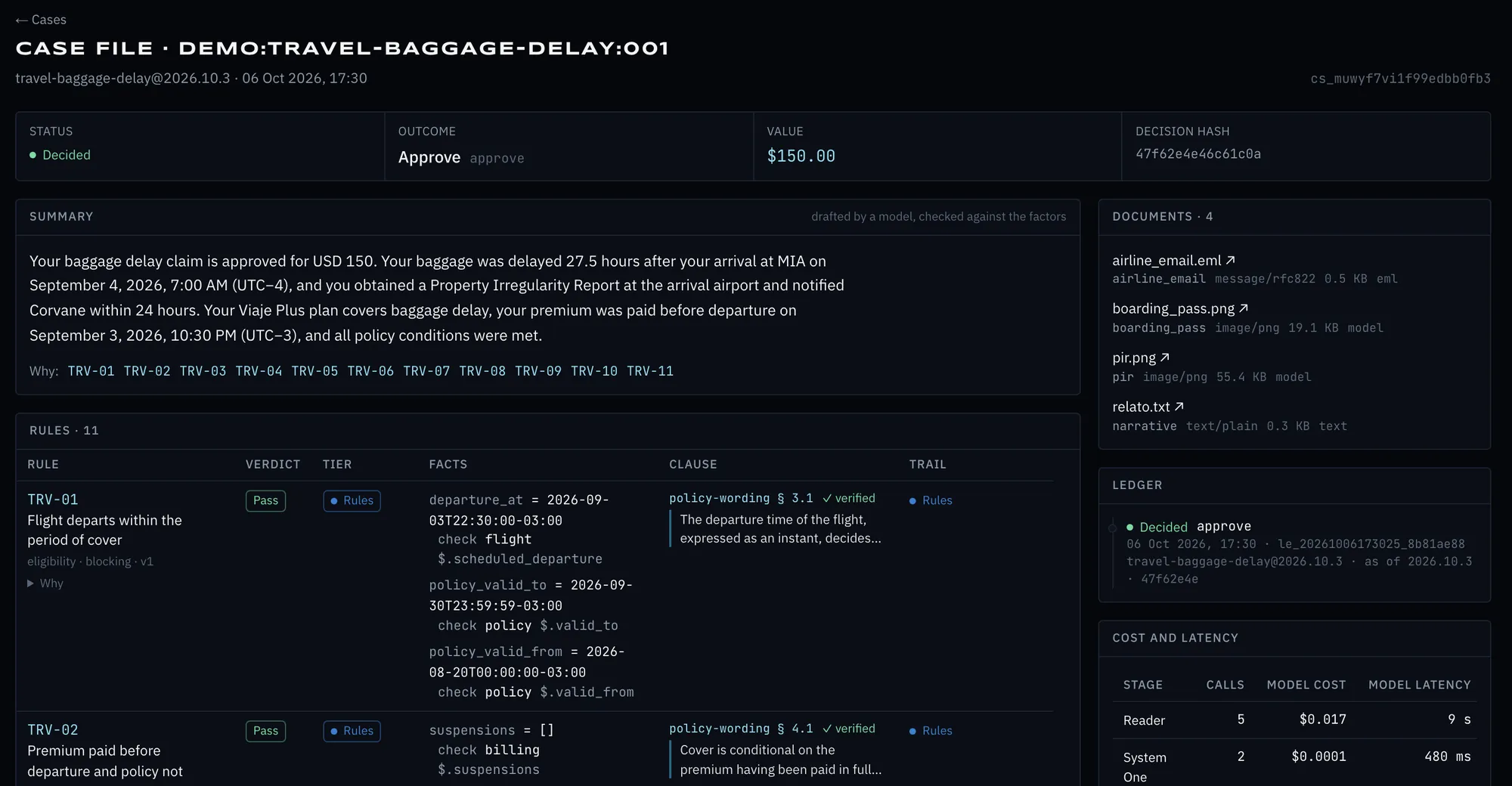
Out comes a decision, not prose: outcome, value, rule-by-rule justification, the tier that settled each rule, cost and time. Paying or notifying is up to your business.
See oneMeasured, not promised
Our largest measurement: 501 decisions under the configuration running in production (Jev as System One, uncalibrated, and a stricter threshold to approve on the expense-purpose rule). Bayes escalates when it isn’t sure; even so, 1.2 % came out wrong without escalating, none of them adverse, and here is each one.
- correct, or escalated when escalating was right: 442 of 501. Another 53 (10.6 %) escalated to a person when the engine could have decided.
- 88.2 %
- v1.1 · 167 test cases × 3 runs, re-decided
- wrong without escalating, 6 of 501, and none adverse: two return cases (3 runs each) where the reader rejected a real photo as “not a photograph” and the engine asked for photos instead of declining, which was not the expected outcome. The expense with a doubtful purpose that used to be approved now escalates to a person: that rule needs more than 90 % confidence to approve.
- 1.2 %
- v1.1 · 167 test cases × 3 runs, re-decided
- of 265 generated cases read without a reader error: 5 misreadings or misclassifications and 2 real photos rejected as not photographs
- 97.4 %
- v1.1 · 265 generated cases
- wrong without escalating, before and after the adjustment. Before: 444 / 48 / 9, with 3 approvals of a doubtful expense. The first evaluation, on a smaller set, had 0 of 93 (81.7 % decided as expected).
- 9 → 6
- v1.1 before the adjustment · v1, 31 cases × 3 runs
- System One with Jev, per case
- ~US$0.0001 · ~0.9 s
- v1.1 · p50
- per full case, median of the 501 decisions; by process US$0.0305 for travel claims, US$0.015 for returns and US$0.0162 for expenses. Most of the time goes to reading documents.
- US$0.017 · 14.6 s
- v1.1 · live test run, Oct 6, 2026
Synthetic cases for three fictional companies, not customers, with real documents and real models. Decisions: 167 test cases × 3 runs = 501, measured live in October 2026 and re-decided from the ledger, with the recorded model answers, under the current production configuration (v1.1). Reader: 265 generated cases (v1.1). v1: 31 reference cases × 3 runs.
A real decision, straight from the case file.
Two delayed-baggage claims as the production engine recorded them. Pick a rule to see the facts it used, the document quote behind each one and the clause it rests on.
This explorer needs JavaScript. The case file is also in the repository, as the engine returned it.
Static snapshot of GET /v1/cases/{id}?full=true from api.bayes.engineering, taken on October 6, 2026. Fictional insurer, airline and passengers; synthetic documents.
One engine, three businesses.
Bayes knows nothing about insurance, returns or expenses: each process is a package of rules. These three exist today, each with its reference cases.
-
Corvane Travel Assurance
Travel insurance
Delayed-baggage claims, checked against the policy wording, the flight record and the airline’s report.
Case 001 Bag delivered 27.5 hours after landing in Miami. Approve USD 150 · three full 8-hour periods of USD 50 US$0.0305 per case · median of 171 decisions -
Pellinor Goods
Returns and refunds
Return requests checked against the store’s policy, the order and the customer’s photos.
Case 032 USD 1,899 laptop; the customer sent a drawing instead of a photo. Request photos · the image is not a photograph US$0.015 per case · median of 168 decisions -
Ostrander Vey Instruments
Expense approval
Expense claims checked against the travel and expense policy, the trip and the receipt, line by line.
Case 024 USD 145 receipt resubmitted, still with USD 45 of alcohol. Approve part, USD 100 · alcohol is not reimbursable US$0.0162 per case · median of 162 decisions
Fictional companies and synthetic documents, written for the reference cases.
Every decision can be checked later.
Quotes verified literally
Each fact points to a document quote, a response from your systems or a field of the case. A quote that isn’t in the document doesn’t count.
Acceptance criteria per document
A photo has to be a photograph: an illustration is rejected with its reason and requested again.
Homoglyphs normalized
NFKC plus folding of confusable characters to Latin. If the original mixed alphabets, the fact keeps a
mixed_scriptmark.Append-only ledger
Nothing is edited or deleted. A person’s answer is a new entry that continues the escalated one.
Reproducible
Every decision can be replayed from its case file and compared by its decision hash.
Archived, not deleted
Test cases are archived and leave the metrics, but stay in the ledger.
Your policy, as data you can read.
A policy package is readable YAML: rules, typed facts, tables and declarative checks against your systems. Each rule quotes its clause, and the quote is verified against the source when the package is published.
id: TRV-09
version: 1
title: { en: Delay not caused by customs or another authority, es: La demora no se debe a la aduana ni a otra autoridad }
kind: exclusion
severity: blocking
basis:
  - source: policy-wording
    clause: "14.c"
    quote: "retention or seizure of baggage by customs authorities or by any other government authority"
test:
  not:
    ask:
      type: boolean
      question:
        en: Was the baggage delay caused by retention or seizure by customs or another government authority?
        es: ¿La demora del equipaje se debió a una retención o un decomiso de la aduana o de otra autoridad estatal?
      look_at: [narrative, airline_email, pir]
      confidence: 0.90
tiers: [system_one, reasoning, human]14. Exclusions
Corvane will not pay for baggage delay arising from:
14.aany flight that is not a covered flight;
14.bthe return flight to the Insured's country of residence, meaning any flight whose destination is in the country where an Insured resides;
14.cretention or seizure of baggage by customs authorities or by any other government authority.
id: TRV-08
version: 1
title: { en: Delay of at least 8 hours, es: Demora de al menos 8 horas }
kind: eligibility
severity: blocking
basis:
  - source: policy-wording
    clause: "12.1"
    quote: "for each full period of eight (8) hours of delay, counted from the actual arrival of the covered flight until the baggage is delivered to the Insured"
  - source: policy-wording
    clause: "12.2"
    quote: "Periods of less than eight (8) hours are not paid"
test:
code: delay_hours >= 812. Baggage delay
12.1If the Insured's checked baggage is delayed by the airline, Corvane will pay the amount stated in the schedule of benefits for each full period of eight (8) hours of delay, counted from the actual arrival of the covered flight until the baggage is delivered to the Insured.
12.2Periods of less than eight (8) hours are not paid, and the total benefit is limited to the maximum stated in the schedule of benefits for the plan purchased.
- Immutable versions. A published version never changes; a new rule or wording is a new version.
- The right version for each case.
as_ofpicks it by event date, processing date or an explicit version. - Checks against your systems. Declarative calls with their responses kept in the case file.
One API, over HTTP or MCP.
Send a case with its data and documents; get back the decision with every rule. OpenAPI 3.1 and llms.txt describe the API, and the MCP server gives agents the same engine.
curl -X POST "https://api.bayes.engineering/v1/cases?wait=true" \
  -H "Authorization: Bearer $BAYES_API_KEY" \
  -H "Content-Type: application/json" \
  -d '{
    "package": "travel-baggage-delay",
    "occurred_at": "2026-09-04T07:00:00-04:00",
    "data": {
      "policy_number": "VP-260101",
      "flight_number": "VM100",
      "flight_date": "2026-09-03",
      "reported_at": "2026-09-04T11:30:00-04:00"
    },
    "documents": [
      { "name": "pir.png", "content_base64": "iVBORw0KGgo…" },
      { "name": "airline_email.eml", "content_base64": "RnJvbTog…" },
      { "name": "relato.txt", "text": "Llegué a Miami el 4 de septiembre…" }
    ],
    "callback_url": "https://your-app.example/bayes"
}'{
"case_id": "cs_muwyf7vi1f99edbb0fb3",
"status": "decided",
"outcome": "approve",
"decision": {
"value": { "amount": 150, "currency": "USD" },
"package": { "id": "travel-baggage-delay", "version": "2026.10.3" },
"rules": [ … 11 rules, each with verdict, tier, facts, evidence and basis … ]
},
"decision_hash": "sha256:47f62e4e46c61c0a…",
"usage": { "cost_usd": 0.029598, "latency_ms": 10749 }
}# Demo client only: runs a reference case with its own documents
curl -X POST https://api.bayes.engineering/v1/demo/travel-baggage-delay/001 \
-H "Authorization: Bearer $BAYES_API_KEY"
# Then follow it
curl https://api.bayes.engineering/v1/cases/cs_muwyf7vi1f99edbb0fb3?full=true \
-H "Authorization: Bearer $BAYES_API_KEY"claude mcp add --transport http bayes https://api.bayes.engineering/mcp \
--header "Authorization: Bearer $BAYES_API_KEY"- Callbacks signed with HMAC-SHA256Bayes-Signature
- Rate limit per client120 calls / min
- Human-facing text in English and Spanishlang=en | es
- Policy packages versioned and listedGET /v1/packages
MCP tools
submit_caseget_caseexplain_caselist_packages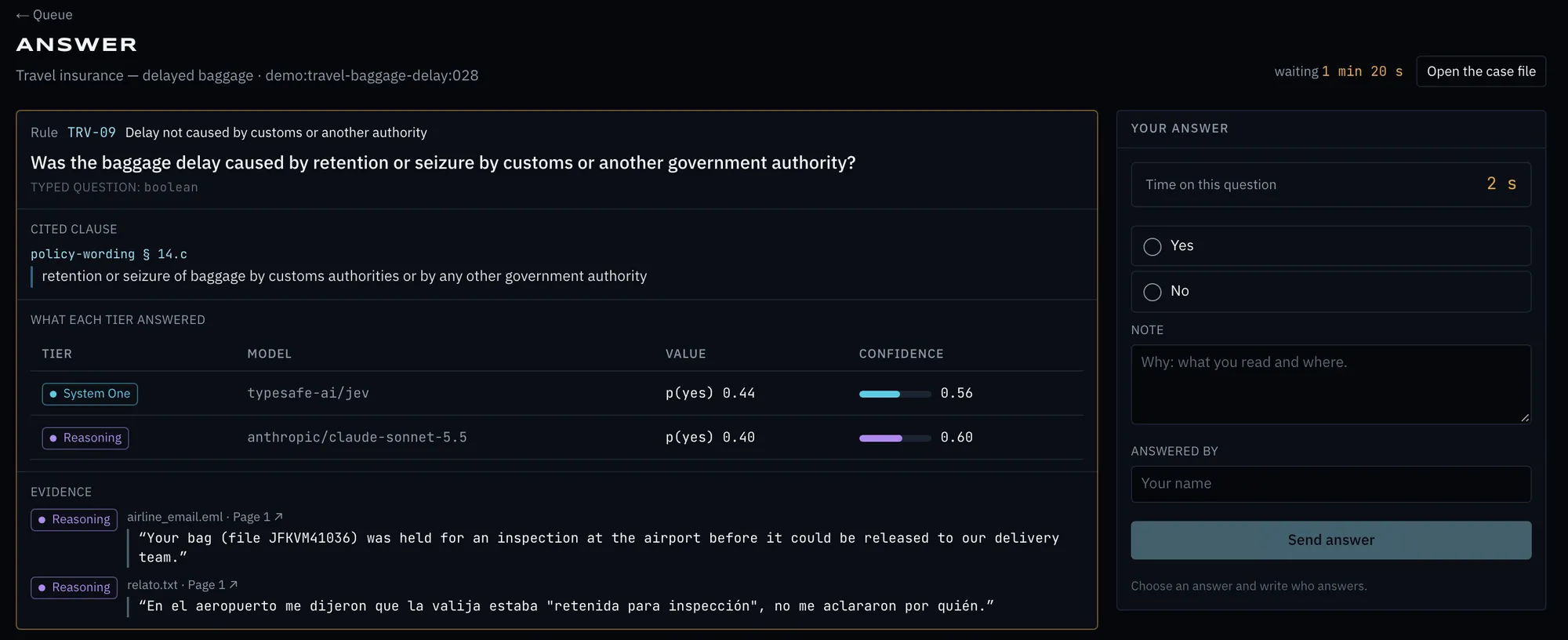
Bayes decides. Paying, refunding or notifying stays with your business.